THE GUINEA PIG SCIENTIST: ETHICS OF SELF-EXPERIMENTATION IN LITERATURE
DOI:
https://doi.org/10.54695/jibes.354.0103Keywords:
contemporary fiction; artificial language; artificial emotions, institutions and forms of governmentalityAbstract
The aim of this article is to see whether the different representations of scientific self-experimentation in literature allow for broader ethical and epistemological reflection on this issue. The foundations of ethical reflection on self-experimentation, and the various arguments for and against it, will be presented, since this is a case of ambiguous bioethics that is far from unanimous. Three literary examples, Altered States (1978) by Paddy Chayefsky, Blood Music (1985) by Greg Bear and “Exhalation” (2008) by Ted Chiang, will then be analyzed from a comparative and epistemocritical perspective. The focus will be on the reasons that motivate the fictional scientists to choose self-experimentation, the experiment itself, its consequences for the researcher’s body and mind, and the world around him.
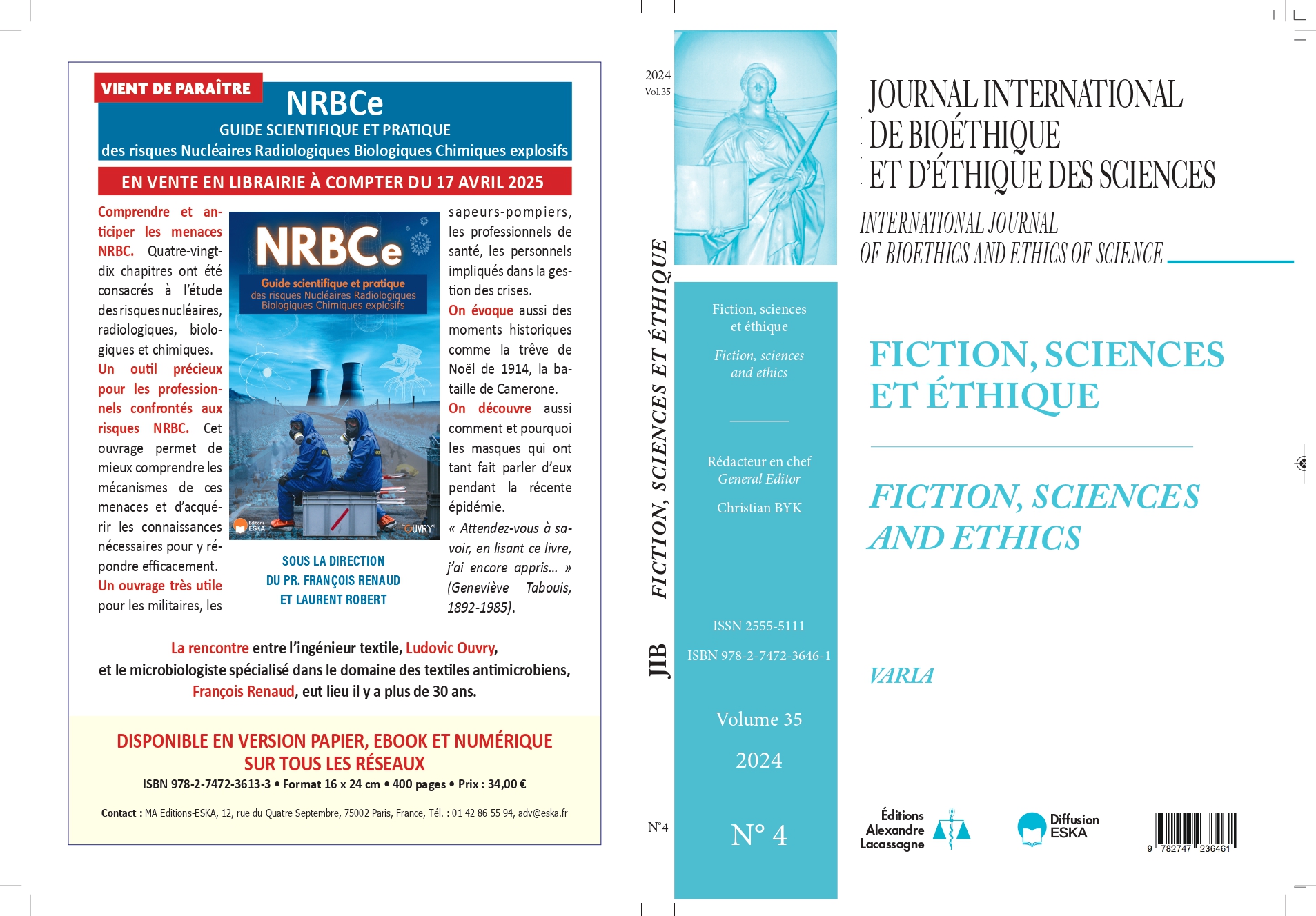
Published
How to Cite
Issue
Section

This work is licensed under a Creative Commons Attribution-NonCommercial-ShareAlike 4.0 International License.