Organ collect or donation?
DOI:
https://doi.org/10.54695/jibes.371.0113Keywords:
organ donation, organ removal, criteria for death, consent to transplantation, donation refusalAbstract
The success of organ transplants has led to an increase in prescriptions, resulting in a shortage. Campaigns calling for organ donations are regularly organised by the Biomedicine Agency in France. However, the refusal rate among families of deceased individuals appears to be increasing. The trust of the families of deceased donors is based both on the medical assurance that the deceased is truly dead and on the consent to donation. However, the criteria for death (cardiovascular death, brain death, brainstem death) are evolving and, due to constant technical progress, may give the impression that they are no longer irreversible and are often counterintuitive. The law, for its part, strives to respect the deceased, their families and those awaiting transplants, and provides for the possibility of refusing consent whereas legislation ensures that such refusals are minimal. To respect the deceased and patients awaiting transplants, and to maintain trust in medicine and in the law, it is important that organ donation is truly a donation. Paradoxically, only refusals allow organ donation to be a donation.
Published
How to Cite
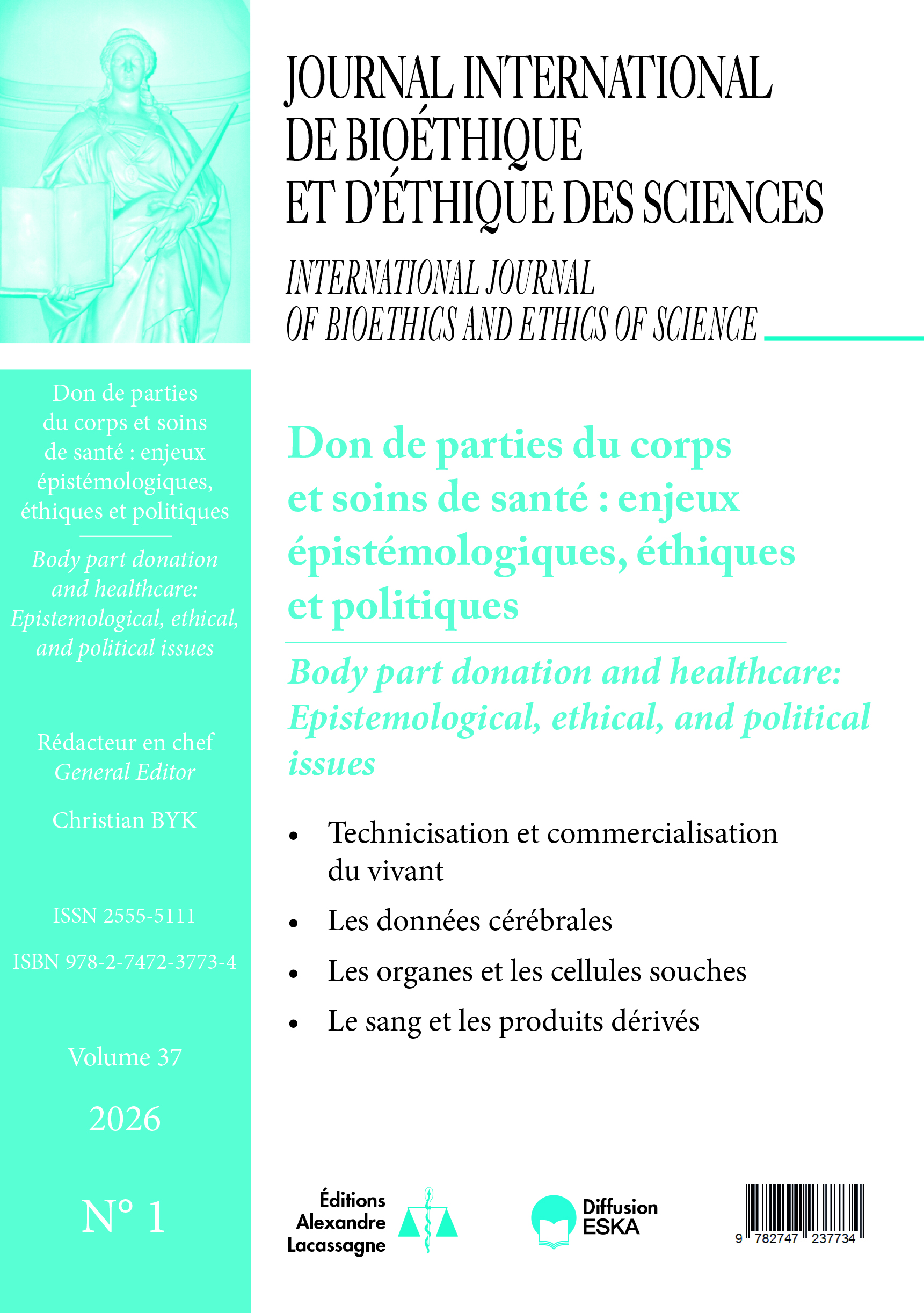
Issue
Section
Copyright (c) 2026 JOURNAL INTERNATIONAL DE BIOÉTHIQUE ET D'ÉTHIQUE DES SCIENCES

This work is licensed under a Creative Commons Attribution-NonCommercial-ShareAlike 4.0 International License.