

Archives
-

Maghreb-Machrek
No. 250-251 (2022)La fragmentation des territoires, les trafics et la prédation des ressources aux fondements de l’émergence du terrorisme en Libye : Comment le Fezzan est-il devenu un sanctuaire de Daech ?
Rafaa TABIB
La protection sociale en Tunisie : Genèse et extension aux travailleurs informels
Nidhal BEN CHEIKH et Jean-Yves MOISSERON Reconstruction et ville informelle à Damas : logiques croisées
des politiques urbaines en contexte de conflit Valérie CLERC EU–Mediterranean policies in the field of industry in Egypt Jean-Yves MOISSERON, Selma FAZZANI and Khaled GUESMI Promouvoir l’économie sociale et solidaire dans la région MENA : enjeux et contraintes
Philippe ADAIR, Vladimir HLASNY, Mariem OMRANI et Kareem SHARABI ROSSHANDLER
Inégalités de genre entre les jeunes en Afrique du Nord : écarts de revenu et emploi informel
Philippe ADAIR et Hassiba GHERBI -

MM
Vol. 241 No. 01 (2019)Iraqi Kurdistan: A State within a State
The muslim brotherhood and the tempo of islam radical:
an interpretation testIran’s trade with the United Arab Emirates and Qatar:
an axis of resistance against american “maximum pressure”?Falling in line: Arab pop music echoes growing political
and social constrictionUK-GCC relations after Bre xit, The del usio ns of “GlobalBritain"
-

MM
Vol. 240 No. 01 (2019)Living treasures, common goods and tourism in the Agdal
of Yagour in the Zat valley – Western High Atlas, MoroccoGlobalization of networks of craftsmen/women in the Moroccan
hinterlandtourism and agricuLture in the high atLas VaLLeYs
Financing and activities of women in rural areas of Morocco
Morocco’s regional ambitions in Sub-Saharan Africa: Royal
diplomacy -

MM
Vol. 239 No. 01 (2019)The place of sustainable tourism in Morocco’s tourism development
strategy for 2020Trust and e-tourism in Morocco
Effects of motivation and quality of life on the subjective well-being
and behavioral intentions of ecotourists in TunisiaThe dynamic process of touristic attractiveness of a territory through
the valorization of the immaterial cultural heritage: an asset of creative
tourism in MoroccoPerception of scientific tourism in Moroccan University: case of
Mohammed V University RabatMorocco’s tourism development strategy for 2020: analysis of its
contribution to the fight against the regional imbalanceA study of the relationships between the economic performance and
the sustainability of the tourism and their methods of management:
an economic analysis of the mass tourism in TunisiaProtected areas of the algerian Sahara, between traditions and contemporary
issues: prospects for ecodevelopment in the heart of cultural
parks of Tassili-Ahaggar (Algeria)Tourism potentials, strategic asset of the revitalization of the local
economy in Algeria -

MM 237-238
Vol. 237 No. 01 (2018)Algeria: which a Chinese economic presence?
Djamaa El Djazair a new ideological dimension for the Bay of
AlgiersThe socio-economic motives of the insecurity in southern Tunisia
For a redesign of Tunisian-European relations or how to enable
Tunisia be successful in its economic transition -
MM
Vol. 236 No. 01 (2018)Les travailleurs migrants dans la région du Golfe
La société israélienne et ses minorités sexuelles :
du prisme de la tolérance au risque de « pink washing » ?La situation juridique de la femme syrienne ou l’émancipation
au prisme du politique : un statut fragile et minorisantRefugees as Minorities: Displaced Syrians as a “New Minority”
in Lebanon’s Sectarian Power-Sharing
SystemLa gouvernance de la diversité en Égypte
Old and New Minorities in the Middle East: Squaring the circle
through common solutionsModern Islamic Theorizing on Minorities: An Alternative Model
-
MM
Vol. 235 No. 01 (2018)Les Kurdes du Moyen-Orient
: une minorité nationale trans-étatiqueLe Mouvement Houthite au Yémen : d’une minorité
politico-religieuse
à une stratégie d’hégémonieLes minorités en Irak : Tour d’horizon
The West African Community in Jerusalem: process
of settlement and local integrationDéfinir l’ennemi national : Restauration sécuritaire et production
des « minorités » en Égypte durant la présidence d’Al-Sissi -

MM 233-234
Vol. 233 No. 01 (2017)Les armées arabes : acteurs économiques d’envergure diverse
L’état islamique (DAESH) une menace militaire relative pour
une menace politique majeureLes forces de sécurité palestiniennes : un appareil répressif indigène
au service de la puissance coloniale ?L’armée turque et la démocratie avant 2015
Les Peshmergas face à Daesh : forces et faiblesses de combattants
mythifiés -

MM 231-232
Vol. 231 No. 01 (2017)Sociologie des forces armées arabes : éléments théoriques et cas pratiques
L’avenir de l’institution militaire dans les pays arabes en transition :
réconciliation et nouvelle légitimitéLa dimension ethnico-confessionnelle et tribale des forces armées :
facteur de puissance ou source de déstabilisation pour les États
arabes ?L’armée et l’Égypte : l’âme et le pouvoir
Les milices chrétiennes au Liban
-
MM
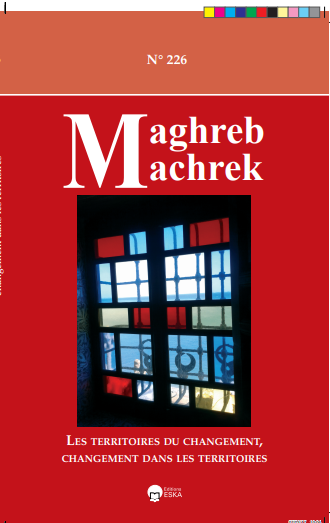
Vol. 226 No. 01 (2015)Old Recipes for New Planning Projects in Egypt:
An “Urban Counter-Revolution” Underway?The state in stalemate. The employment crisis
in the interior regions of post-revolutionary TunisiaRural territories in Tunisia to the test of communalization:
complexity of the reform and political stakesRegional reforms in France and Tunisia. Theoretical
and methodological elements to identify seen territoriesThe Tunisian Territory in the Constitution of 2014
Regionalization and Territorial Equity :
towards a new Territorial Governance in Tunisia -

MM 224-225
Vol. 224 No. 01 (2015)THE SHARIA AND THE STATE
AGAINST HISTORICAL DETERMINISM, WITH REGARD TO ISLAM AS TO ANYTHING ELSE
THE ARAB REVOLUTION IN THE MAKING: THE PARADIGMATIC CASES OF EGYPT AND
TUNISIABETWEEN STATE AND RELIGION: RETHINKING CIVIL SOCIEY AND CIVIL STATE AFTER THE
ARAB REVOLTSISLAM AND POLITICS IN CONTEMPORARY LIBYA
RECENT DEVELOPMENTS OF THE SECULARISM IN TURKEY
THOUGHTS ON SECULARIZATION DURING THE FIRST CENTURIES OF ISLAM
PHILOSOPHY OF A POST-FUNDAMENTALIST ISLAM
RELIGION AND POWER
THE KORAN IS ESSENTIALLY GUIDANCE
A NON-HERMENEUTIC READING OF THE KORAN: THE LITERAL ANALYSIS
-
MM
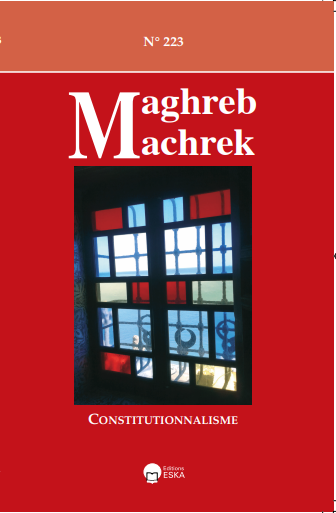
Vol. 223 No. 01 (2015)THE LIBYAN SITUATION: THE ANALYSIS OF A DOUBLE CRISIS
BARHEIN: THE CONSTITUTION IN THE HEART OF CONFLICTS
THE CONSTITUENT PROCESS AND THE TUNISIAN CONSTITUTION: A MODEL TO FOLLOW?
THREE PROMISES FROM THE NEW MOROCCAN CONSTITUTION
THE NEW EGYPTIAN CONSTITUTION: CONTEXT AND PROGRESS
THE SPRING OF THE CONSTITUTIONAL COURTS
-

MM
Vol. 219 No. 01 (2014)THE WESTERN SAHARA CONFLICT AND THE GENERAL OF THE UNITED NATIONS:
A MOROCCAN POINT OF VIEWSTAKEHOLDERS’ ROLE IN THE GOVERNANCE OF THE COMMUNAL DEVELOPMENT PLAN IN
MOROCCOSOCIO-CULTURAL NORMS OF MOROCCAN YOUTH: CASE STUDY OF MARRAKECH TENSIFT
AL HAOUZ -

MM
Vol. 218 No. 01 (2013)LES MUTATIONS DE L’ÉCONOMIE LIBANAISE SOUS L’IMPACT DE LA CRISE SYRIENNE
VIOLENCE AND DISPLACEMENT: THE SYRIAN REFUGEE CRISIS IN LEBANON
REFUGEES OF SYRIA AND THE SUNNI-SHI’I TENSION IN LEBANON: BETWEEN CHALLENGES
AND PERILSHEZBOLLAH IN SYRIA: RESISTANCE REDEFINED?
THE SYRIAN CRISIS: A “SHOCK THERAPY” FOR THE LEBANESE MEDIA
CONFLIT EN SYRIE ET DYNAMIQUES DE GUERRE CIVILE À TRIPOLI, LIBAN
LES CHRÉTIENS LIBANAIS FACE À LA CRISE SYRIENNE : ENTRE DHIMMITUDE ET CITOYENNETÉ
RESPONSABLE -

MM
Vol. 217 No. 01 (2013)ALGERIAN ENTREPRENEURSHIP FACING A LACK OF INCLUSIVE GOVERNANCE: A
CONVENTIONALIST APPROACH TO EXPLAIN THE ENTREPRENEUR’S BEHAVIOR IN A
HOSTILE ENVIRONMENTTHE FINANCIAL INCLUSION AROUND THE MEDITERRANEAN. CASE OF TUNISIA
REFORMS OF CORPORATE GOVERNANCE AND STRUCTURE OF THE TUNISIAN FINANCIAL SYSTEM
THE REASONS FOR THE DUAL PRACTICE OF PHYSICIANS: THE CASE OF ALGERIA
1-25 of 30
Next


