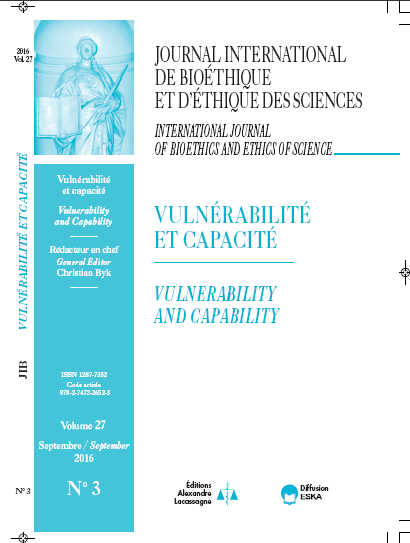
Care beyond autonomy: the reCognition of our vulnerable Capabilities
DOI:
https://doi.org/10.54695/jib.27.03.3396Palabras clave:
Autonomy, Vulnerable populations, Moral philosophy, Ethical principles, Quality of health care, Clinical ethics.Resumen
The use of the category of vulnerability has been multiplied in moral philosophy
social sciences and bioethics. Being vulnerable can refer rhetorically to all
mortal agents, but also to those lacking agency which makes of it a very
ambiguous notion.
The notion of vulnerability is part of everyday language and is mostly perceived
as a determination which limits our aspirations to autonomy. Why has it become
a notion a bioethical principle or concept per se? Historically, anthropology of
the vulnerable subject is needed and can be found in the work of Nussbaum and
Honneth which could be used in bioethical discourse.
The link between care theory and capability of recognition theories developed by
Sen and Nussbaum, enrich the picture. Vulnerability we will argue does not have
to be from an anthropological point of view, exposition to dependence and
exploitation.